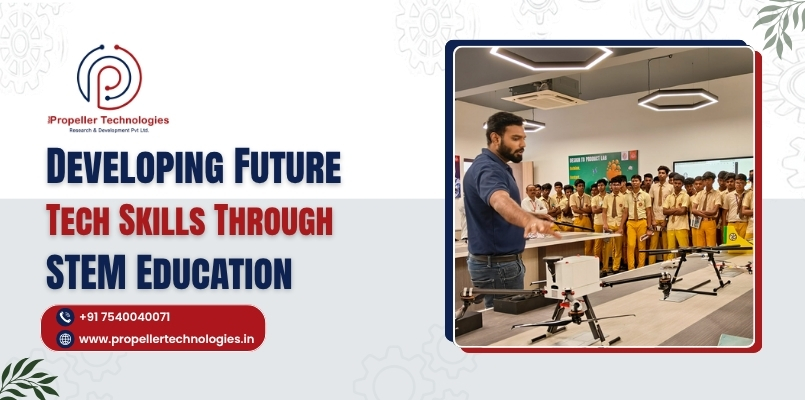
Children build stronger concepts through curiosity and STEM Education in India from Propeller Technologies turns that spark into classroom projects nationwide. Under the guidance of founder Aashik Rahman, who brings over nine years of classroom and curriculum experience, the company has partnered with more than four hundred and seventy schools across the country. Instead of textbook memorization, students engineer simple machines, write basic code and test science models, learning by doing rather than repeating. This approach gives children an early, practical relationship with technology that stays with them well beyond the classroom.
STEM Classes for Kids
Every child learns at a different pace, which is why structured classes matter more than random exposure to gadgets or apps. These classes introduce robotics kits, simple circuits and beginner coding step by step, letting a child move from basic assembly to independent building. Sessions are kept small so instructors can notice where a child struggles and adjust the pace accordingly. Rather than rushing through a syllabus, the focus stays on understanding why a mechanism works, not just how to copy a finished model. That distinction builds lasting technical confidence.
Hands-On STEM Activities
Many children lose interest in science the moment it turns into rows of formulas and definitions to memorize before an exam. Hands-on activities reverse that pattern by putting a working model, sensor or small robot directly in front of a learner. A child measures, wires and tests instead of copying notes from a board and mistakes become part of the process rather than something to avoid. Building a simple alarm circuit or a moving cart makes physics and logic visible, which keeps attention longer than any diagram on a page.
STEM Workshops For Kids
Weekend and holiday workshops give children a concentrated block of time to finish a project they cannot always complete in a regular weekly class. Propeller Technologies runs these sessions as an extension of its wider STEM Education in India work, bringing the same curriculum into a shorter, intensive format for students nationwide. A workshop might centre on building a line-following robot or a basic weather station, with every participant leaving with a finished, working project rather than partial notes. Parents often notice a visible jump in confidence after just one such session.
Certified Mentors And Curriculum
A program is only as strong as the people teaching it, which is why mentor quality shapes everything else in the classroom. Founder Aashik Rahman has spent over nine years designing curriculum and training instructors and that experience now informs every lesson plan used across more than four hundred and seventy partner institutions. Mentors are trained not just in robotics or coding tools but in reading a child’s frustration and adjusting explanation style on the spot. Curriculum updates happen regularly as new tools and teaching methods emerge, keeping lessons relevant rather than static year after year.
STEM Education in India Overview
Looking at STEM Education in India as a whole, the picture varies sharply between well-funded urban schools and smaller towns with limited lab access. Propeller Technologies was built to close that gap by delivering the same kit-based, project-driven curriculum to schools in a metro city and a smaller district alike. The overview matters because policy documents often describe goals in broad terms, while actual classroom delivery depends on trained mentors, working equipment and a curriculum sequence that builds skill over months, not a single workshop day.
Young Innovators Learning STEM
Curiosity shows up early in most children, often before they can even explain what a machine does or why it moves. That instinct, if nurtured consistently, turns into genuine problem-solving ability by the time a student reaches early teenage years. Programs built around young innovators give children space to attempt, fail quietly and retry a build without pressure from grades or deadlines. Over repeated sessions, a shy student who once avoided tools starts leading a group project, which is often the clearest sign that STEM learning has taken root rather than stayed theoretical.
Robotics Coding Electronics Basics
Before a child touches an advanced robot kit, a few basics need to be firm: how current flows through a simple circuit, what a sensor actually senses and how a line of code becomes a physical action. These fundamentals are taught through small, testable projects rather than long lectures on theory. A student might wire an LED to blink on command before ever attempting a moving robot, building understanding layer by layer. Skipping this stage often leaves children able to follow instructions but unable to troubleshoot when a wire is loose or code has a small error.
Science Experiments For Children
Simple kitchen-table experiments often teach concepts that a textbook diagram cannot fully convey to a young learner. Watching a homemade volcano erupt or a battery light a small bulb creates a memory tied to the underlying chemistry or physics, which sticks far longer than a memorized definition. Structured experiment sessions guide children to predict an outcome first, then test it, building a habit of forming a hypothesis before checking results. This habit carries directly into how a student approaches maths problems and coding bugs later, since both reward patient, methodical checking over guesswork.
Mathematics Logical Reasoning Skills
Robotics and coding projects quietly reinforce mathematics far more effectively than repeated worksheet drills ever manage to. Calculating a wheel’s rotation speed, measuring an angle for a sensor mount or estimating how much time a program loop needs all require applied arithmetic and basic geometry in context. Logical reasoning develops alongside this, since debugging a program forces a student to trace cause and effect step by step rather than guess randomly. Over time, children start applying the same structured thinking to unrelated school subjects, from word problems to comprehension questions that require sequential reasoning.
Weekend Batch Timing Options
Balancing school, tuition and extracurricular commitments is a real constraint for most families choosing an additional program. Weekend batches solve part of this by moving sessions outside weekday school hours, while shorter evening slots on weekdays serve families who prefer to spread learning across the week instead of concentrating it. Batch sizes stay small enough that a mentor can check individual progress rather than teach to an average pace. Parents can usually switch between weekend and weekday timing as school schedules shift through the academic year, without restarting the curriculum from the beginning.
Online Offline Class Formats
Some children focus better in a physical room with a kit in front of them, while others manage attention well through a screen with the same kit delivered to their home. Both formats follow an identical curriculum sequence, so a student switching from offline to online or the reverse, does not lose continuity mid-course. Online sessions use screen sharing and video to walk through wiring and code changes in real time, while offline sessions add group activities that build a small amount of healthy competition. Choosing between the two usually comes down to a family’s daily schedule rather than any real gap in outcome.
Certificate Upon Course Completion
A certificate at the end of a level gives a child tangible proof of the skill built over months of sessions, beyond just a parent’s verbal encouragement. Each certificate maps to a specific set of demonstrated abilities, such as building a working sensor circuit or writing a short control program, rather than simple attendance. Students often add these certificates to school portfolios or competition applications, where documented, project-based experience carries real weight. Completion also marks a natural point to decide on continuing toward a more advanced level or exploring a different STEM track altogether.
Propeller Technologies
Website | Instagram | Facebook | Twitter
Address: No.30, Kalyanasundram Nagar, opp. to Arokiya Matha Matric School, IOB Nagar, Karumandapam, Tiruchirappalli, Tamil Nadu 620001
Phone: 075400 40071