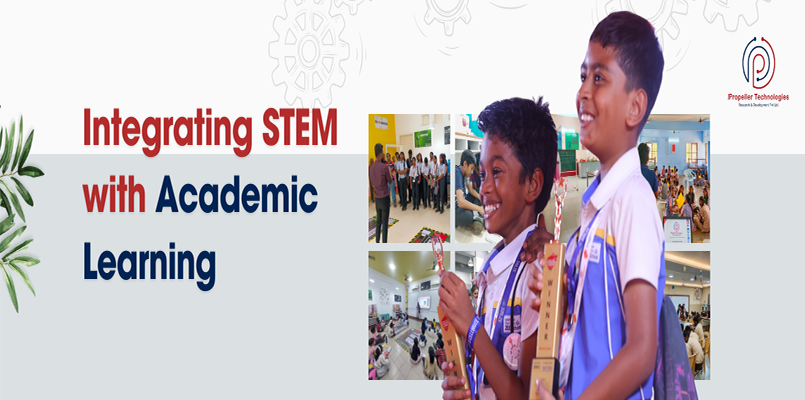
STEM education is crucial in shaping the future of students by bridging the gap between theoretical knowledge and practical application. Our academically integrated STEM training sessions provide students with hands-on learning experiences that not only help them grasp complex subjects more effectively but also enable them to excel academically. Here’s how our program benefits students:
1. Bringing Textbook Concepts to Life
Many students struggle with abstract concepts in science and mathematics. Our STEM training sessions incorporate interactive experiments, real-world applications, and problem-solving exercises that make these subjects easier to understand. By working with tangible models and simulations, students can visualize and grasp theories with greater clarity.
2. Encouraging Hands-On Learning
Traditional classroom education often focuses on rote learning, but our STEM sessions emphasize experiential learning. Through activities like robotics, coding, and physics experiments, students engage in practical applications of their subjects, fostering deeper understanding and retention of knowledge.
3. Strengthening Critical Thinking and Problem-Solving Skills
STEM training encourages students to analyze problems, test hypotheses, and develop solutions. This process enhances their analytical thinking and helps them tackle academic challenges with confidence. These skills are not only beneficial for STEM subjects but also transferable to other areas of study.
4. Boosting Confidence in STEM Subjects
Many students perceive STEM subjects as difficult or intimidating. By participating in hands-on projects and seeing the real-world impact of their work, they develop confidence in their abilities, making them more likely to excel in their academic performance.
5. Enhancing Collaboration and Communication
STEM training often involves teamwork, where students collaborate to solve problems or complete projects. This improves their ability to work effectively with others, communicate their ideas clearly, and develop leadership skills, which are essential for both academic and professional success.
6. Bridging the Gap Between Theory and Application
Understanding concepts in isolation can be challenging, but when students apply their learning in practical scenarios, they develop a more comprehensive understanding of their subjects. Our STEM sessions ensure that students connect classroom knowledge with real-world applications, reinforcing their academic curriculum.
7. Preparing Students for Future Careers
With an increasing demand for STEM professionals, early exposure to these fields can provide students with a competitive edge. Our training sessions equip students with foundational skills in technology, engineering, and scientific research, helping them explore potential career paths and academic pursuits.
Academically integrated STEM training sessions transform learning by making it interactive, engaging, and relevant. By experiencing hands-on applications of their subjects, students not only understand academic concepts more easily but also develop essential skills that prepare them for success in both their studies and future careers. Investing in STEM education today ensures a brighter, more innovative tomorrow.